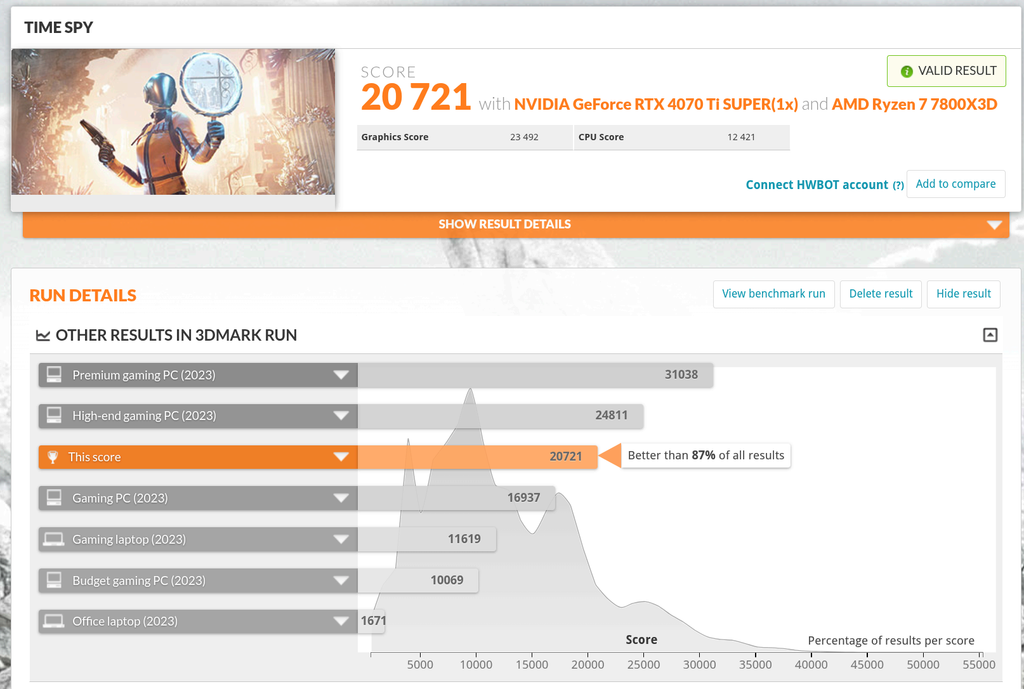
I have a regular cadence for building PCs. My first PC was bought in 1994. The next one was in 1999. A laptop in 2004. Then desktops in 2009, 2014, 2019 and 2024. A 5 year gap between PC builds, with frequent GPU upgrades along the way to keep up with hardware requirements. But sometimes, extreme situations and extenuating circumstances can change even the best laid plans. I wasn’t looking to build a new PC for another 3 years, because my existing Windows box already scored better than 87% of all results on 3DMark Time Spy:
This is the story of how and why I built Gilgalad in December 2025, right as DDR5 prices started climbing out of control. A 32GB kit of Corsair Vengeance Pro DDR5 6000 CL36 I’d bought for S$120 in 2024 was going for S$500 by the time it went in the machine, if it had gone in clean. Which it didn’t. Murphy’s law strikes again!
The RAM was supposed to be for a server
I bought that kit in 2024 to build BigBlackBox, my Windows workstation (the one with the 20,721 score above). It made the machine unstable, so I bought a second kit and dumped the first one in a drawer. RAM was cheap, and I didn’t think too much about it. The plan was always to reuse it eventually: a third Proxmox node to round out the cluster, or a new HTPC.
The rest came home in a suitcase
In November 2025 I was in Japan, and that’s where the CPU, motherboard and GPU came from. All three flew home with me instead of arriving in a box:
- Ryzen 9 9950X
- Asus ProArt X870E-Creator WiFi
- Sapphire Pulse RX 9070 XT
Tax-free shopping for tourists cuts a real chunk off the price, and Japan has an odd quirk where AMD GPUs run noticeably cheaper than the Nvidia equivalent, the opposite of most markets. I got the 9950X and the ProArt motherboard from Tsukumo during their Black Friday sale, bought deliberately for what was meant to be the ultimate Proxmox server, with enough cores (16 cores / 32 threads) to round out the cluster properly. That server is where the name Gilgalad comes from. The RX 9070 XT was a different story.
The following Monday (Cyber Monday), Tsukumo slashed the price on it and I rushed down to grab it, too good a deal to pass up. I didn’t have a plan for it at the time, I figured it’d replace either the RTX 4070 Ti Super in my Windows box or the GTX 1070 in the HTPC. What made it an easy buy either way was that AMD’s Linux driver support is genuinely good, which turned out to matter a lot more than I expected.
Then a mini PC took the job
Before any of those parts went into a case, a second-hand Lenovo M90q showed up. A tiny form-factor mini PC is a much better fit for a 24/7 cluster node than a full tower: lower power draw, quieter, no wasted silicon. It would fit nicely in my mini-rack too. The M90q took the node job, which left a 9950X, a ProArt motherboard and the drawer RAM with nowhere to go. So I did what any self-respecting nerd would do and built a desktop instead!
The drawer RAM still didn’t work
I pulled the kit out in December 2025 and it failed memtest immediately, same instability that killed it in BigBlackBox a year earlier. I took it to the distributor for a warranty claim, in the middle of a shortage that had already pushed the same kit to S$500.
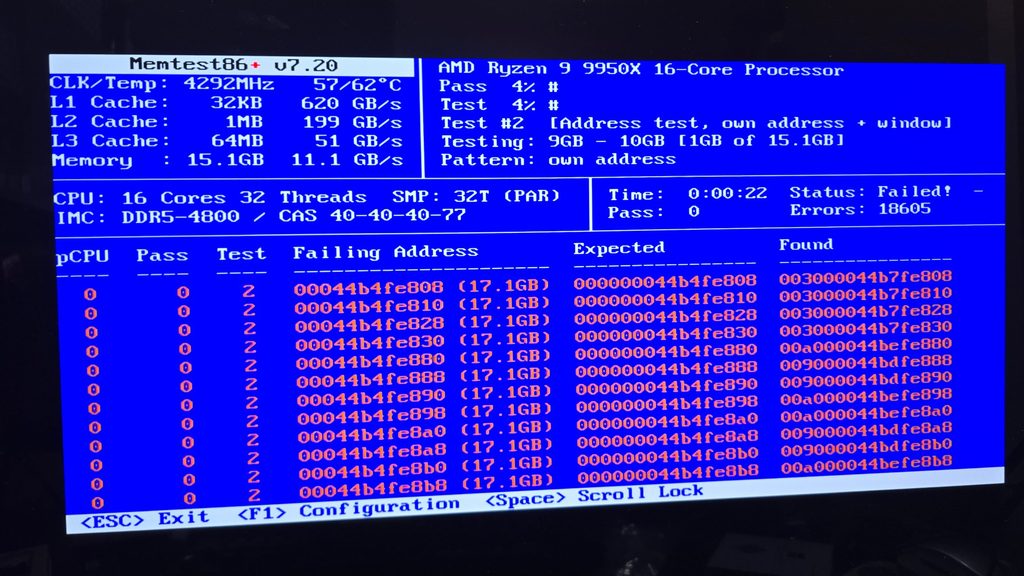
They told me straight: no matching kit in stock means it goes back to Corsair for repair, and in a RAM crisis that’s not a fast turnaround. The service guy checked the warehouse anyway and came back with the last matching kit they had, an immediate 1:1 swap. Gilgalad exists because of that one find.
What’s in it
- Motherboard: Asus ProArt X870E-Creator WiFi
- RAM: Corsair Vengeance Pro DDR5 6000 CL36 (S$120 kit, warranty-replaced mid-shortage when it was worth S$500)
- SSD: Samsung 9100 Pro 2TB (OS), 2 x Verbatim Vi5000 2TB (Storage)
- GPU: Sapphire Pulse RX 9070 XT
- Case: Fractal Design Define 7 Compact
- Cooler: Thermalright Peerless Assassin SE 120
- PSU: Corsair RM850x
- OS: CachyOS
- CPU: Ryzen 9 9950X at build (see below)
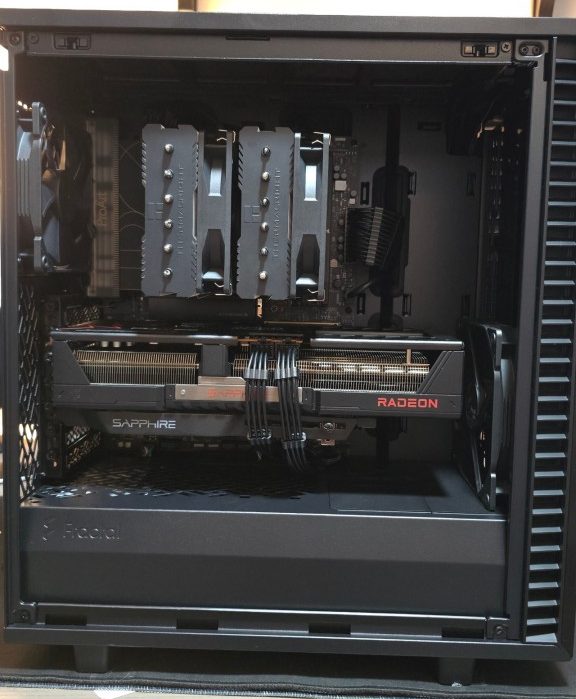
I must say, that’s one clean build, and not a single RGB in sight! The total price was approximately S$2,100. A similar spec will easily run to S$3,500 today. I love a good deal!
The 9950X didn’t stay
It’s not in Gilgalad anymore. I swapped it into BigBlackBox, which needed more cores for audio, video, photo and data processing work that’s still Windows-only, no good Linux equivalent for parts of that pipeline. The cores went where they’d actually get used. Plus that box runs a 280mm AIO, which is better suited to tame the temperatures of the Zen 5 beast!
Gilgalad picked up a Ryzen 7 7800X3D in the trade. For a Linux desktop that isn’t running the same workload, the 3D V-Cache is arguably the better fit anyway.
The cooler is overkill, and that’s fine
The Thermalright Peerless Assassin SE 120 is more cooler than the 7800X3D needs. Day-to-day, nothing I throw at it pushes past 75°C. OCCT, a synthetic stress test built to find the ceiling, gets it closer to 90°C, but that’s a worst-case number I never see in real use. At idle it sits around 50-55°C, which is normal for Zen X3D chips, roughly 20°C above ambient, a consequence of the stacked V-Cache die rather than a cooling problem.
To Windows or Not to Windows
I had an actual Windows licence key ready to go (from the grey market). I just couldn’t bring myself to put the bloated, AI-ridden, hunk-of-junk that’s the modern Windows on my new beautiful machine. So I went looking for a Linux Distribution (i.e. distro-shopping). I considered all the usual suspects:
- Debian
- Fedora
- Ubuntu
- Linux Mint (which is already running on my HTPC)
- Bazzite
I read reviews and watched videos, and I noticed one distro that kept appearing in comments: CachyOS. To be honest, I had not heard of it before, but once I started doing my research, it became apparent pretty fast that this was the OS for me. I’ll do another post to talk about CachyOS, but I can say I have ZERO regrets about choosing to go with it. Suck it Micro-slop!
No 3DMark, so Geekbench and Heaven
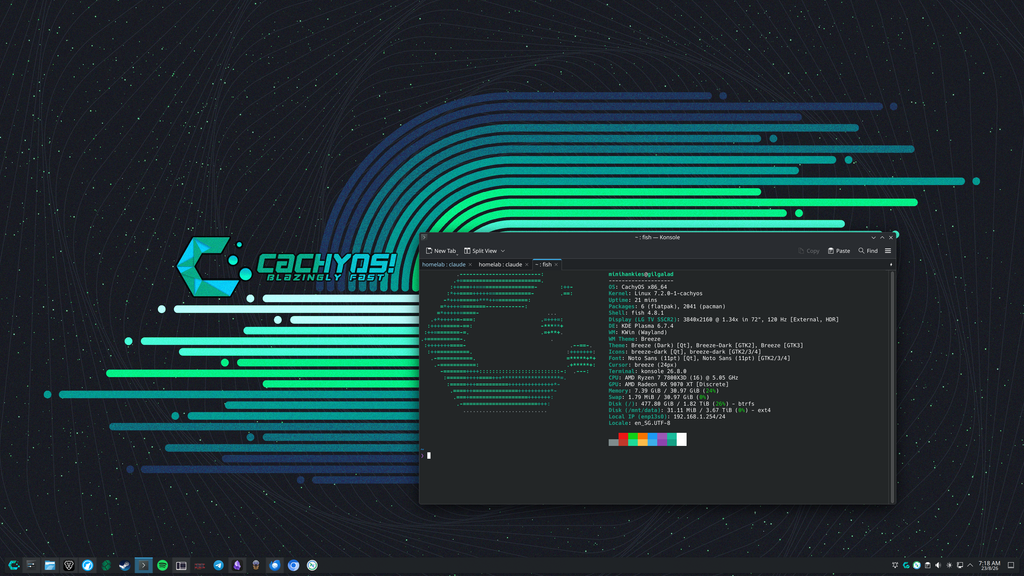
3DMark has no native Linux build, and Proton doesn’t rescue it: Steam’s Linux client never writes the product key that unlocks Advanced mode, so the benchmark falls back to Demo and won’t produce a score at all. That rules out a like-for-like Time Spy comparison with the Windows box, so Geekbench and Unigine Heaven had to stand in.
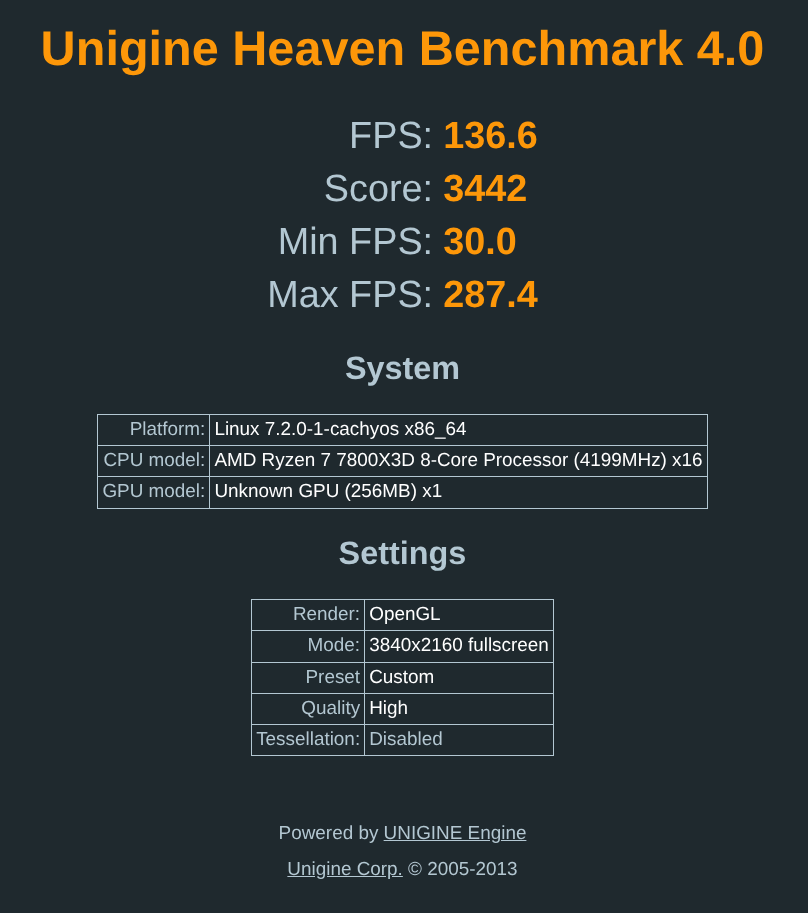
Geekbench 6 gave 2883 single-core, 15849 multi-core. Unigine Heaven 4.0 at 4K, High quality, tessellation off, OpenGL, gave 3442, averaging 136.6 FPS, dipping to 30 and peaking at 287.4. Heaven also reported the GPU as “Unknown GPU (256MB)”, a Mesa/OpenGL detection quirk, not the RX 9070 XT quietly downgrading itself.
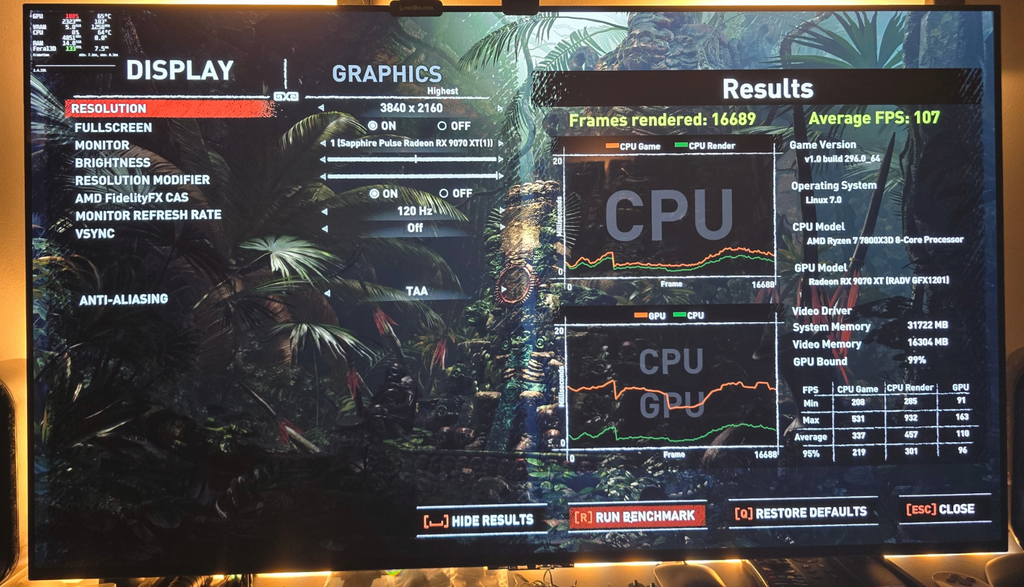
In actual gaming, I fired up my favourite, Shadow of the Tomb Raider. At 3840 x 2160 on the Highest preset with TAA and FidelityFX CAS on, it averaged 107 FPS across 16,689 frames, GPU-bound 99% of the time, with the GPU’s own low sitting at 91 FPS. That is a 4K number on max settings with room to spare.
One caveat worth stating plainly: the Windows box runs an RTX 4070 Ti Super and Gilgalad runs an RX 9070 XT, so this is two different GPUs rather than a clean Windows-versus-Linux measurement. What it does tell me is that nothing about running on Linux is leaving performance on the table.
Where it actually stands
Gilgalad is a Proxmox node that became a desktop, built on parts bought cheap in Japan and RAM that had to be fought for twice, once with memtest, once with a distributor’s warehouse. Not the build I was expecting (for another 3 years at least), but one that I’m using more than my actual Windows workstation for Gaming, content consumption and anything AI related. 2026 is finally the year of Linux (for real this time!).
NB: Why Gilgalad? He’s the last High King of the Noldor. Nobility, powerful and wise, and he holds the alliance of Men and Elves together at exactly the moment it’s needed. The name was picked for the Proxmox node this hardware was supposed to become. The node never happened, but the name had already stuck, so the desktop inherited it.